Add a service
A service is the unit you actually deploy. It lives inside a project, runs inside an environment, and ships as one or more spherelets.
This page covers creating one — from the console, the API, or the CLI.
Service types
| Type | What it is | Detail page |
|---|---|---|
| Web service | Long-running HTTP service with a public URL and zero-downtime rollouts. | Web service |
| Background worker | Long-running process with no inbound traffic — queues, schedulers, daemons. | Background worker |
| Cron job | Runs on a schedule. Spherelet starts, executes, exits. | Cron jobs |
| Datastore | SphereDB (PostgreSQL), SphereCache (Valkey) or SphereQueue (RabbitMQ). | Datastores |
Pick the type that matches the workload — the rest of the create flow asks the right questions for that type.
Create a service
-
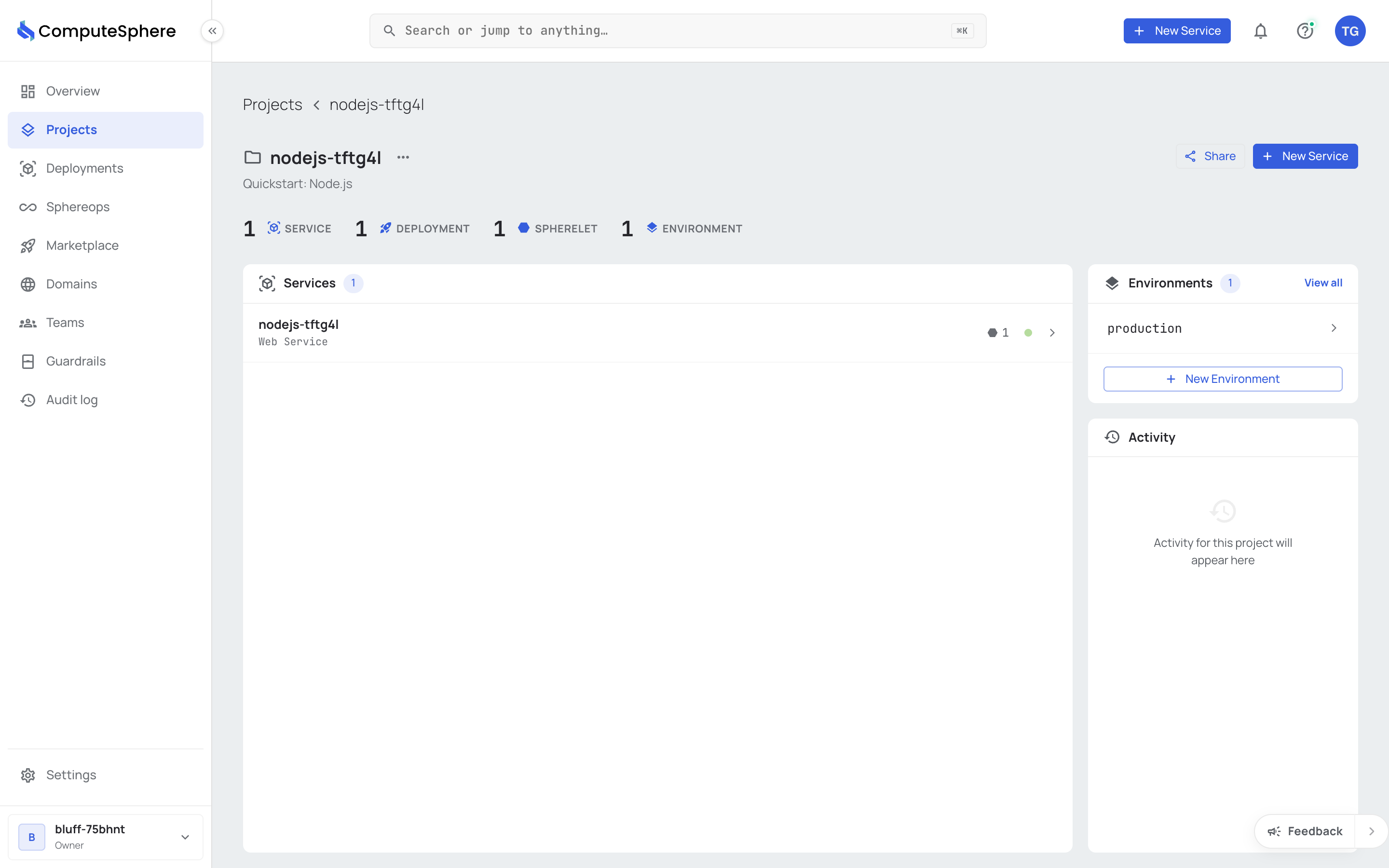
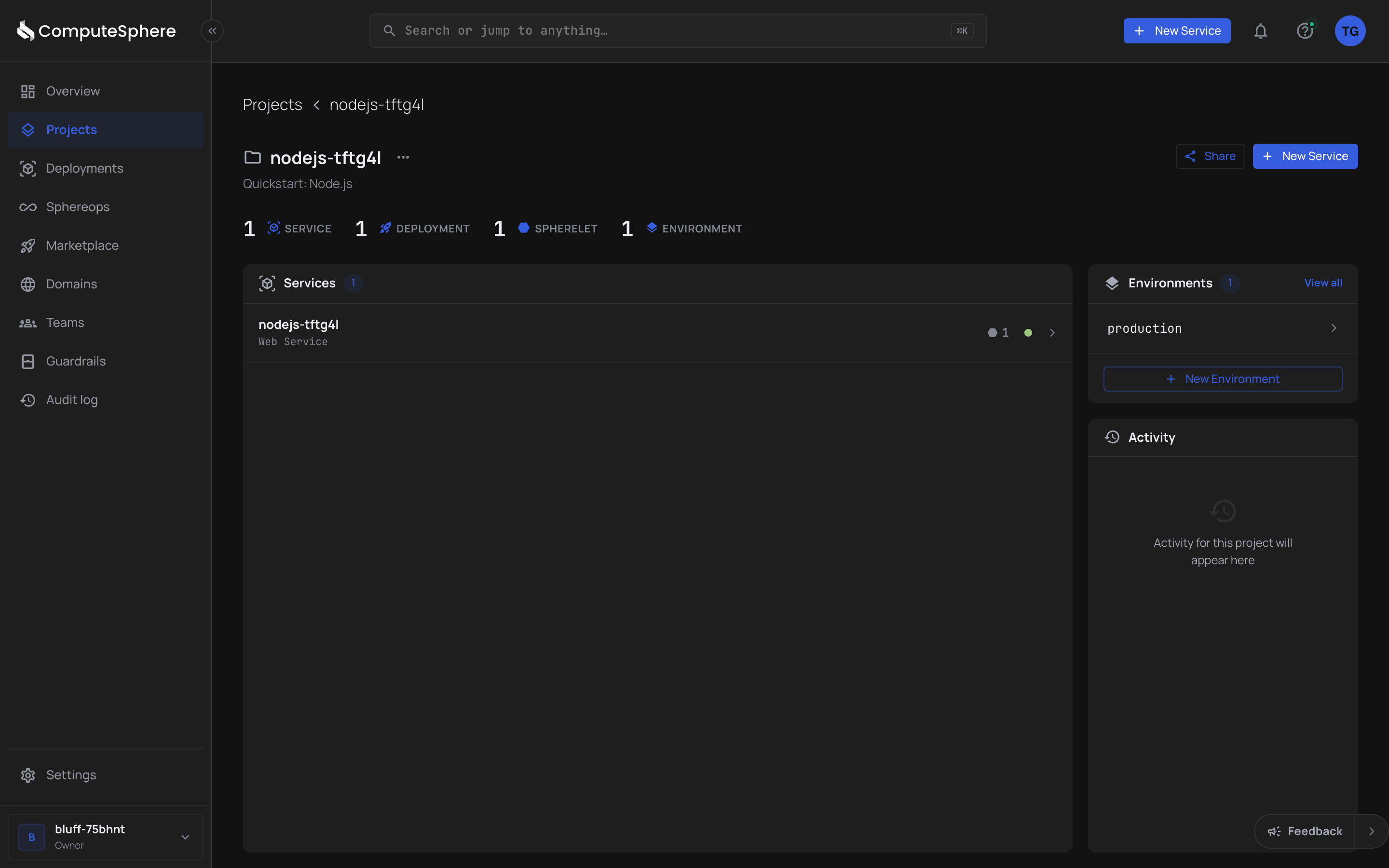
Open the Projects tab in the console and pick the project the service belongs to.
-
Inside the project, click New Service.


-
Pick the service type. Each type has its own setup questions:
- Web service / background worker — connect a Git repo or paste a container image URL, set environment variables, pick a spherelet shape and count.
- Cron job — same as above, plus a cron expression for the schedule.
- Datastore: for SphereDB (PostgreSQL), pick a size, a version and the storage. For SphereCache (Valkey), pick a name, a size and what happens when memory is full. For SphereQueue (RabbitMQ), pick a name and a size. See Datastores.
-
Confirm and create. The first deploy fires immediately. You can watch it from the service's Deployments tab.
For language-by-language Web service walkthroughs (Node, Python, Go, Ruby, PHP, Java, Elixir), see the Quickstart.
Honest limits
- A service belongs to one project + one environment. To run the same code in
stagingandproduction, you create two services and deploy them in parallel from the same source. - Service type is fixed after creation. You can't convert a web service into a cron job; create a new service of the right type and migrate.
- Datastore provisioning isn't fully self-serve in every region yet. The Postgres / Valkey / RabbitMQ pages list what's available; check those before promising a customer a specific datastore.
- Service name uniqueness is per-environment. Two services in the same environment can't share a name; across environments is fine.
What's next
- Web service — HTTP services, health checks, scaling.
- Background worker — non-HTTP long-running workloads.
- Cron jobs — scheduled jobs.
- Environments — where the service runs.
- Spherelets — picking shape + count.